Disruptions don’t announce themselves before they drop. Whether it’s a ransomware attack at midnight, a supply chain collapse, or a regulatory audit gone wrong, organizations that depend on traditional continuity plans discover their loopholes at the worst possible moment. Here’s how to know if you’re already behind. And if yes, then a Business Continuity Management Software is something that’s really important for you.
Business continuity is no longer a “nice to have” experiment. With cyber threats escalating, climate-related disruptions rising, and regulatory bodies demanding documented and recorded resilience frameworks, organizations of every size struggle with a hard question: are we actually prepared, or do we just think we are?
For the majority, the honest answer is the latter. Spreadsheets, shared drives, and annual tabletop exercises create the illusion of readiness, but when a real incident occurs, these tools simply cannot keep-up with the speed, complexity, or coordination required.
This is exactly where Business Continuity Management (BCM) software becomes a non-negotiable at times of a critical mission. Below are five unmistakable signs your organization needs to make the switch immediately.
74% of organizations experienced a disruptive incident in the past 3 years
$1.4M average cost of a single business continuity failure
58% of BCM plans fail due to outdated documentation at time of incident
Your Recovery Plans Live in Static Documents No One Updates
Ask yourself: when was your Business Impact Analysis (BIA) last updated? Who is responsible for reviewing your recovery time objectives (RTOs) and recovery point objectives (RPOs) on an ongoing basis? If these questions produce silence or uncertainty, your continuity program is running on stale data.
Static Word documents and PDF-based BCP templates were a reasonable starting point a decade ago. Today, they are a liability. Organizations change constantly, new vendors, new team structures, new critical processes, new technology dependencies. A continuity plan that doesn’t reflect your current operating environment isn’t a safety net; it’s a false sense of security.
Business Continuity Management software solves this by centralizing all continuity documentation in a live, version-controlled repository. Plan owners receive automated prompts to review and attest to their sections at scheduled intervals. Changes to organizational structure or critical assets automatically flag affected plans for review ensuring your documentation always reflects operational reality.
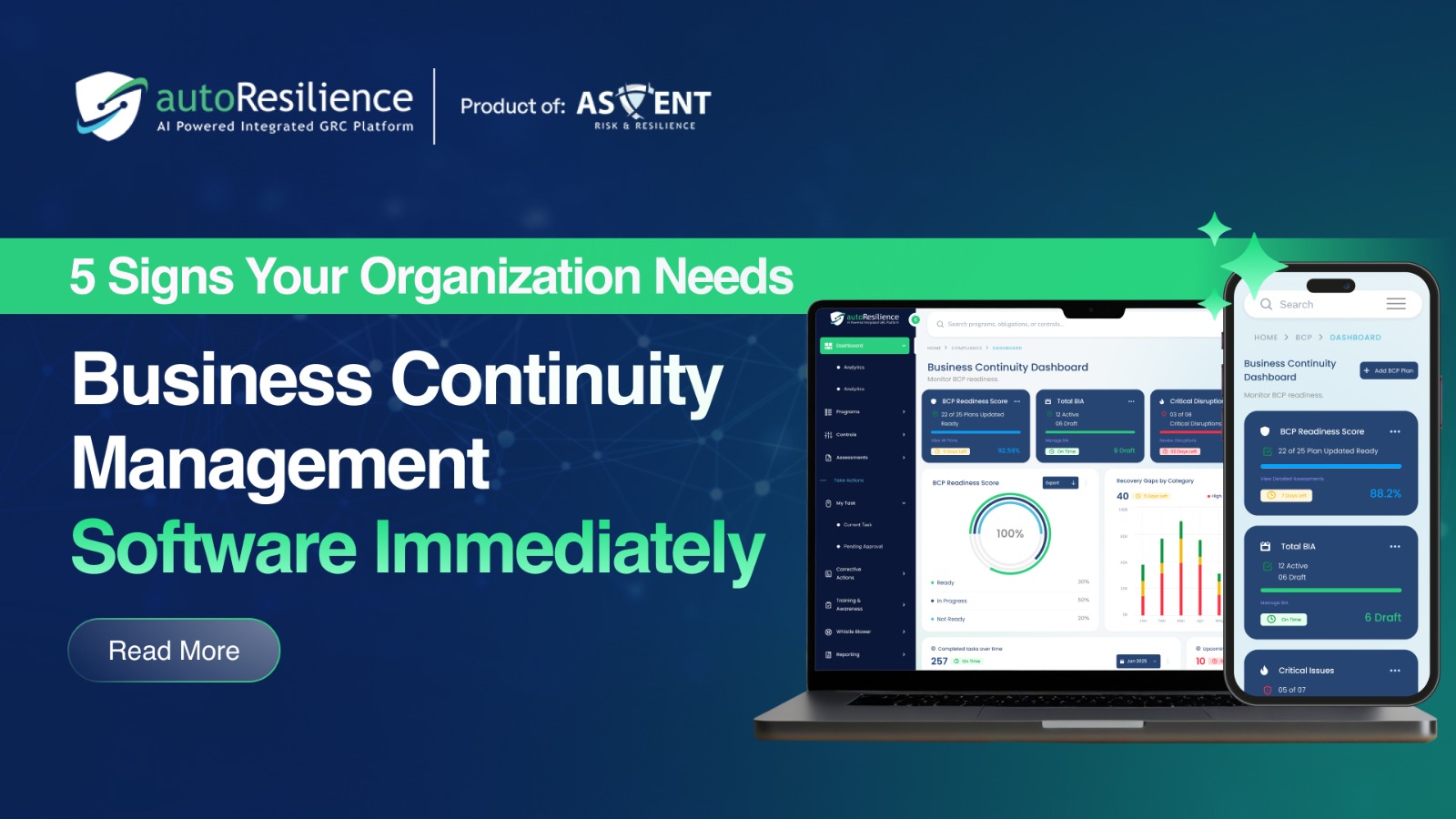
With Ascent’s BCM platform, every plan section carries a review status, an assigned owner, and a timestamp. When you walk into an audit or face an actual incident, you know your documentation is current, because the software ensures it can’t fall out of date undetected.
You Can’t Demonstrate Compliance Without a Fire Drill
Regulatory and contractual compliance expectations around business continuity have intensified dramatically. ISO 22301, DORA, SOC 2, HIPAA, and sector-specific frameworks increasingly require organizations to demonstrate not just that a BCM program exists, but that it is tested, maintained, and effective.
If your response to a compliance request involves digging through shared drives, chasing down the last person who “owned” the BCP document, or scheduling an emergency tabletop exercise to show evidence of activity, your organization is operating in reactive mode. Regulators and auditors have become adept at distinguishing genuine resilience from theatre.
BCM software creates an automatic compliance evidence trail. Exercise records, plan attestations, risk assessments, and change logs are captured in real-time and mapped to specific regulatory requirements. When an auditor asks for evidence, you generate a report, not a scramble.
Ascent’s platform maintains a continuous audit log of every action taken within the system, from plan updates to exercise outcomes to incident activations. Compliance reporting that once took days now takes minutes. More importantly, it’s defensible, timestamped, complete, and accurate.
Incident Response Is Reactive, Never Proactive
There’s a telling pattern in organizations without a mature Business Continuity Management software: they manage incidents by reacting to them rather than executing against a practiced plan. The first hour of a crisis is consumed by figuring out who to call, where the plan is, and what version is current, rather than actually activating a valid response.
This is the operational cost of manual BCM. By the time the right people are assembled and the relevant procedures located, the window for minimizing impact has already narrowed. In sectors where every minute of downtime translates directly to financial or reputational loss, this delay is unacceptable.
- Automated crisis notification to all relevant stakeholders within seconds of activation
- Pre-mapped incident types with linked response procedures and task assignments
- Real-time status tracking across all response workstreams
- Structured decision logging throughout the incident lifecycle
- Post-incident debrief and lessons-learned integration
Ascent’s incident management module connects directly to your continuity plans, so the moment an incident is declared, the relevant plan activates, tasks are assigned, and stakeholders are notified, automatically. Your team stops guessing and starts executing.
You Have No Real-Time Visibility Into Operational Risk
Business continuity doesn’t begin when an incident is declared. It begins with understanding, in real time, where your critical dependencies are, which suppliers carry concentration risk, which processes have inadequate backup coverage, and which parts of your organization are most exposed to disruption.
Organizations relying on annual risk assessments and quarterly BIA updates are effectively navigating with an outdated map. The operational risk landscape shifts continuously, new technology dependencies are introduced, key personnel change, supplier relationships evolve. Without a dynamic view of these dependencies, you cannot accurately model your exposure or prioritize your resilience investments.
Modern Business Continuity Management Software maintain a living map of your critical processes, assets, dependencies, and risk indicators. Changes to any element of this map propagate automatically, giving risk and continuity leaders a current, accurate picture of organizational exposure, not a snapshot that’s already six months old.
With Ascent, your BCM dashboard shows not just plan status, but operational risk posture. Which BIAs are due for review? Which recovery strategies haven’t been exercised in the last 12 months? These insights allow you to act on risk before it becomes an incident.
Cross-Departmental Coordination Breaks Down During a Crisis
Perhaps the most persistent and costly sign of inadequate BCM maturity is the failure of coordination during a live incident. In most organizations, business continuity responsibilities are distributed across IT, operations, HR, communications, legal, and facilities, each with their own playbooks, their own toolsets, and their own chains of command.
Without a shared platform, these teams operate in silos during the moments when coordination matters most. Critical updates are communicated via group email chains. Decision authority is unclear. Task completion is tracked on ad-hoc spreadsheets. Leadership receives conflicting status updates. The incident response that looked smooth in a tabletop exercise disintegrates under the pressure of a real event.
- A single, shared workspace where all response teams operate simultaneously
- Role-based task assignment with real-time completion status
- Escalation workflows that trigger automatically when tasks are overdue
- A unified communications log that keeps leadership informed without requiring constant status calls
- Cross-functional dependency mapping so teams understand how their workstreams affect each other
Ascent’s BCM platform serves as the single system of record during a crisis. Every stakeholder, from the CISO to the Head of Facilities, operates from the same source of truth. Leadership sees a consolidated view. Response teams see only what’s relevant to them. And the entire incident is documented automatically for post-event review.
Conclusion
There is a natural organizational tendency to treat business continuity investment as something that can wait for the next budget cycle, the next compliance audit, or the next near-miss event. This tendency is understandable, BCM doesn’t generate revenue, and its value is most visible precisely when things go wrong.
But the calculus has shifted. The frequency and severity of operational disruptions, whether cyber, climatic, geopolitical, or infrastructural, has reached a level where organizations without mature BCM capabilities are routinely paying the price: in prolonged downtime, regulatory censure, reputational damage, and the loss of customer trust that often follows a poorly managed incident.
BCM software is no longer a tool for large enterprises with dedicated resilience teams. Cloud-based platforms like Ascent have made enterprise-grade continuity management accessible to organizations of every size, with implementation timelines measured in weeks, not months, and total cost of ownership that compares favorably to a single unplanned outage.
If any of the five signs above describe your organization, the question isn’t whether you need BCM software. It’s how much longer you can afford to operate without it. Schedule a free demo now!