Business Impact Analysis: Why is it the Backbone of Business Continuity Management
Disruptions and accidents come without a warning, and there's no going back from this era of uncertainties. In today's fast-moving and unpredictable business landscape, making sense of thes...
Shambhavi Singh
Disruptions and accidents come without a warning, and there’s no going back from this era of uncertainties. In today’s fast-moving and unpredictable business landscape, making sense of these dangers and preparing for disruptions are important. Businesses are exposed to various scenarios like supply chain disruptions, cybersecurity attacks, power outages, third-party risks, etc., that can cause significant losses or damage. Take a moment and imagine: what if an unexpected event occurs and brings your organization’s normal operations to a sudden pause tomorrow? How well-prepared & ready would you be? Most important, how can you nullify the negative impact and bring back everything to normal with a low downtime? The key to proactive protection against operational disruptions begins with the Business Impact Analysis (BIA). It is not just a precautionary tool for risk resolution but also a strategic plan to increase productivity during crises and ensure business continuity.
What is a Business Impact Analysis (BIA)?
A Business Impact Analysis (BIA) is an organized process crafted to determine and monitor the potential consequences of disruptions on the major functions, processes, systems, and overall functioning of a company. This includes, among others, financial losses, legal consequences, reputational damage, and personal safety risks.
The analysis is based on two assumptions:
Company operations depend on mutual functions.
Some parts of the company are more critical & crucial than others, requiring more resources in case of a disruption.
The primary goal of a BIA is to recognize crucial operations and processes and determine when their failure would lead to any disastrous damage. Plus, it assesses how these damages change over a period of time.
To support this, critical measurable factors such as Maximum Tolerable Period of Disruption (MTPD), Recovery Time Objective (RTO), and Recovery Point Objective (RPO) are identified and utilized to guide business continuity planning.
A crucial part of a BIA is highlighting a clear understanding of the dependencies between business processes, IT systems, supply chains, and external partners.
What Is the Purpose of Business Impact Analysis?
The primary purpose of BIA is to prepare enterprises for any looming disruption by recognizing critical business functions and determining how interruptions would affect operations, customer trust, and compliance requirements.
A well-implemented BIA helps enterprises:
Identify which operations are critical to survival
Recognise risks that can be critical to major functions
Manage resource allocation during disruption
Provides long-term continuity and resilience planning
BIA allows wise and confident decision-making when disruptions occur.
Key Areas Addressed by Business Impact Analysis
A whole BIA focuses on several critical areas:
1. Recognising Critical Operations
The first step in an effective Business Impact Analysis is recognizing the most critical functions. Identification of which processes are essential for an on-time delivery of products and services and meeting regulatory obligations. It becomes the most important step since it lessens downtime.
2. Assessing Potential Impacts
The second phase is the monitoring and analysis of financial loss, functional disruption, legal exposure, and decrease in customer trust caused by downtime after a disruption.
3. Prioritizing Recovery Efforts
Prioritizing and categorizing recovery efforts that can help enterprises allocate resources, including people, technology, and finance, to restore the most critical functions first. This would lead to decreased disruption, and the major functions could be restored in the blink of an eye.
4. Supporting Continuity Planning
It gives crucial insights for business continuity and disaster recovery strategies.
At an overall level, BIA enables organizations to:
Recognise the dependencies across jurisdictions, teams, systems, and third parties
Establish Recovery Time Objectives (RTOs) and Recovery Point Objectives (RPOs)
Build a defensible, regulator-ready continuity framework
Business Impact Analysis vs. Risk Assessment
Although often used together, BIA and risk assessment serve different purposes.
Business Impact Analysis focuses on the impact and consequences of disruption and prioritizes recovery.
Risk Assessment, on the other hand, identifies looming threats and assesses their likelihood.
In very simple words:
Risk assessment asks: “What could go wrong?”
BIA asks: “What happens if it does? What happens after that?”
Together, they form an overarching risk and resilience strategy.
Business Impact Analysis vs. Business Continuity Planning
BIA is a major factor, not a replacement, for continuity planning.
Business Impact Analysis defines critical functions, impacts, and recovery priorities.
Business Continuity Planning identifies how operations will be maintained or restored based on BIA findings.
Think of BIA as the diagnostic phase and continuity planning as the execution plan.
Importance of Business Impact Analysis (BIA)
Conducting a BIA is essential for organizations of all sizes because it equips you to:
Reduce Financial Loss by decreasing the downtime
Save Brand Reputation through reliable service delivery
Meet Regulatory Requirements and audit expectations
Enhance Decision-Making with clear recovery points as per priority
Empower Operational Resilience against unexpected issues
Organizations that perform BIAs on a regular basis showcase preparedness, reliability, and operational maturity. These are the most important stakeholders of customer and regulator trust.
When Should You Conduct a Business Impact Analysis?
A BIA should be performed:
During the initial phase, business formation or expansion
After mergers, acquisitions, or major organizational changes
Following a huge disruption or incident
During routine reviews to reflect evolving risks and dependencies
Consistent BIAs make sure that continuity plans remain relevant and important in a changing operational environment.
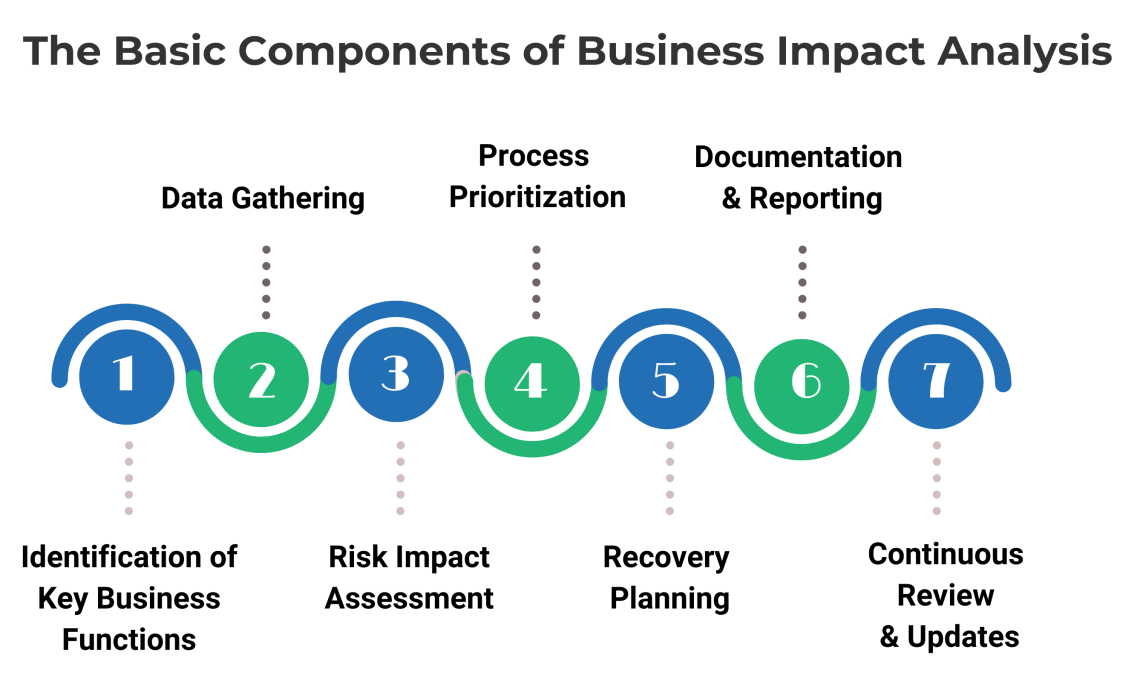
How to Conduct a Business Impact Analysis (Step-by-Step)
1. Define Objectives
Set the long-term goals, including the scope, functions, and outcomes of the BIA.
2. Assemble a Cross-Functional Team
Cross-functional stakeholders come together from a variety of streams and functions to come to common ground. From IT, operations, finance, and HR to compliance, all of these functions come together to find effective solutions.
3. Gather Information
The third phase is conducting interviews, surveys, workshops, records, and historical incident data for the purpose of research and implementation of BIA.
4. Identify Critical Functions
Rank processes based on customer impact, revenue, and compliance needs.
5. Assess Potential Impacts
Evaluate short- and long-term financial, operational, and reputational effects.
6. Define RTOs and RPOs
Set acceptable recovery timeframes and data loss thresholds.
7. Analyze Dependencies
Assess internal systems, vendors, and third-party dependencies.
8. Document Findings
Create a structured BIA report with clear recommendations.
9. Integrate with Continuity Plans
Update BCM and DR plans and validate through testing.
10. Review and Update Regularly
Continuously refine the BIA as business conditions evolve.
Why autoResilience for Business Impact Analysis?
Business Impact Analysis is not just a compliance exercise it is a strategic enabler of resilience.
What are the three stages of Business Impact Analysis?
The three stages of a BIA are initiation, data collection and analysis, and reporting of findings.
What are the five elements of a BIA?
Critical functions, impact assessment, recovery objectives, dependency analysis, and documentation are the five elements of a BIA.
Why is Business Impact Analysis important?
BIA equips organizations to make recovery the topmost priority, decrease disruption, meet regulatory requirements, and empower operational resilience.
Written by
Shambhavi Singh
Shambhavi Singh is a Marketing Executive at Ascent Risk & Resilience, where she contributes to brand communication, content strategy, and digital storytelling across the organization’s risk and resilience solutions. With a background spanning content writing, voice-over artistry, anchoring, public speaking, and social impact, she brings both creativity and clarity to every message she crafts.
Shambhavi’s passion for communication started early in her hometown of Varanasi, where her curiosity for culture and heritage shaped her worldview. A natural storyteller and confident speaker, she has built a strong presence as a social media writer and continues to use her voice to inform, inspire, and engage audiences.
Driven by a blend of will and skill, she is committed to building meaningful connections, leading with empathy, and contributing to initiatives that create positive change. A social worker at heart and a marketer by profession, Shambhavi combines creativity, purpose, and leadership in everything she does.