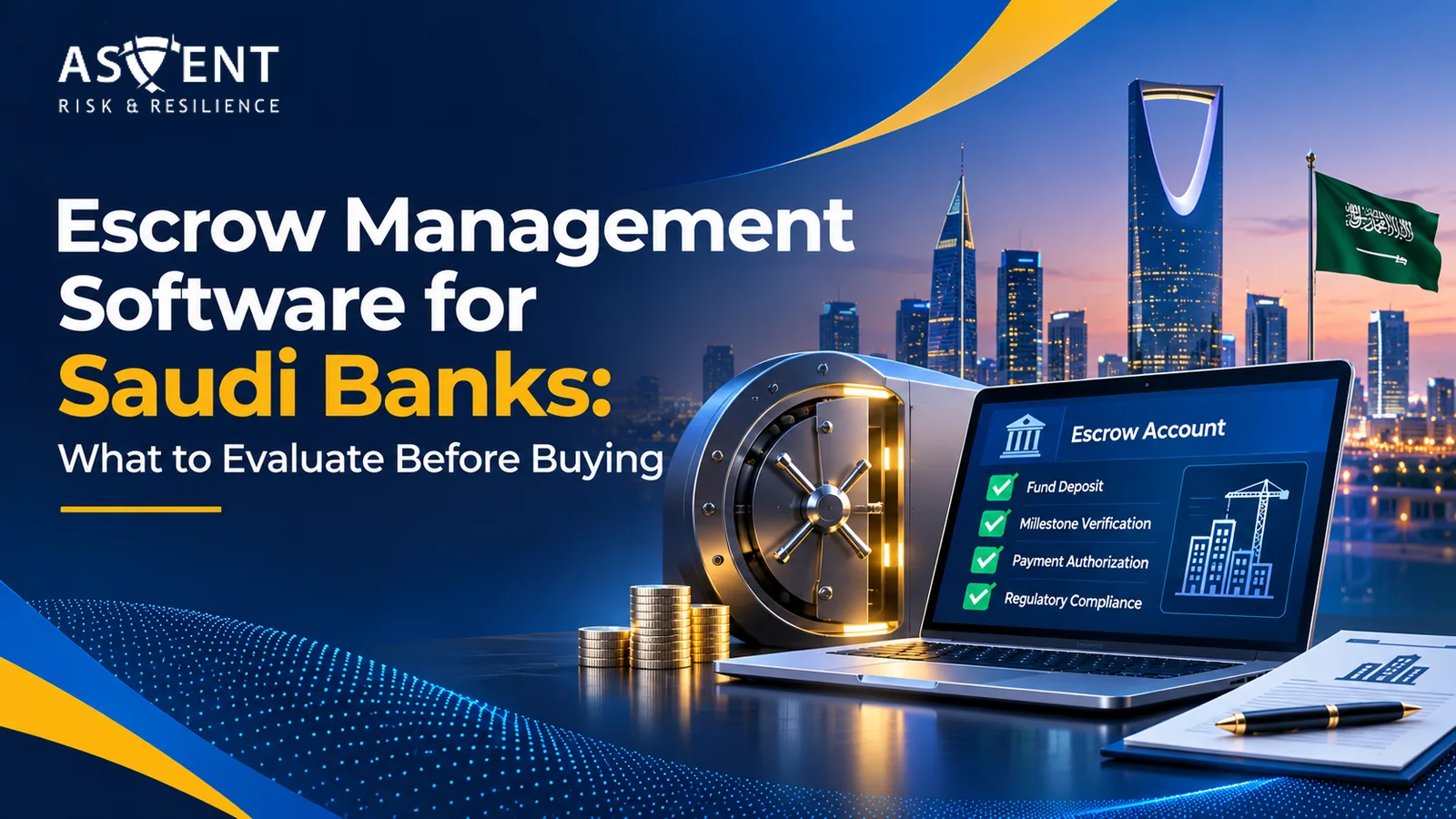
Escrow Management Software for Saudi Banks: What to Evaluate Before Buying
For a Saudi bank, selecting escrow management software is a decision about the control of restricted funds, not simply the automation of account opening. The platform must support the bank'...
Shambhavi Singh
For a Saudi bank, selecting escrow management software is a decision about the control of restricted funds, not simply the automation of account opening. The platform must support the bank’s contractual obligations, financial records and operational responsibilities throughout each account’s lifecycle.
A bank may administer funds for off-plan real estate developments, commercial transactions and project finance arrangements. Each product has distinct participants, documentation and release conditions. As the portfolio expands, manual exceptions and disconnected approvals can make it increasingly difficult to maintain consistent controls.
Procurement teams assessing escrow management software should therefore evaluate both the local regulatory context and the platform’s ability to operate reliably within the bank’s technology environment. This guide focuses on the evidence Saudi banks should require before committing to a vendor.
1. Establish the Bank’s Saudi Escrow Product Scope
Begin with an inventory of the escrow products the bank currently offers and those it plans to introduce. Identify the parties involved, the governing agreement, the source of incoming funds, permissible payments and the evidence required for each release.
Off-plan real estate projects require particular attention to project-level controls. Commercial escrow may instead depend on conditions agreed between transaction parties. Project finance trust and retention accounts may involve reserves, payment priorities and lender instructions. These should not be treated as interchangeable account structures.
Ask the vendor to demonstrate multiple products with independently configurable mandates. Determine whether a new product can be configured through governed settings or requires bespoke development. A configurable platform can reduce implementation friction, but changes to financial rules must still be approved, tested and traceable.
For banks operating across the Gulf, distinguish Saudi requirements from those applying to other jurisdictions. Ascent’s UAE escrow software selection guide provides a complementary perspective, but its jurisdiction-specific requirements should not be copied into Saudi workflows.
2. Evaluate REGA and SAMA Requirements Separately
Saudi Arabia’s Real Estate General Authority (REGA) publishes the Law of Selling and Leasing Off-Plan Real Estate Projects. The law requires a distinct escrow account for each covered project and establishes conditions for activating those accounts. The implementing regulations provide further requirements for administering these arrangements.
A Saudi bank should translate the applicable provisions into its own approved control matrix. Link each requirement to a workflow, accountable role, supporting document and evidence of execution. Ask how the platform handles changes to project licensing status, payment restrictions and authorized signatories.
Separately, assess the bank’s obligations under the Saudi Central Bank (SAMA) supervisory framework. The SAMA Cyber Security Framework and Rules on Outsourcing are relevant considerations when evaluating the security and service delivery model of a banking technology solution.
The bank’s compliance and legal functions should confirm the applicable requirements, regulatory approvals and notifications for the proposed operating model. A vendor’s claim of regulatory alignment is not equivalent to independent approval or proof that the bank’s configured processes meet every obligation.
3. Demonstrate Account Segregation and Controlled Disbursement
A platform should enable operations teams to identify the correct account, understand its restrictions and determine what amount can be released under the approved mandate. Financial segregation must remain effective even when a common team administers a large number of projects.
Request a demonstration using two projects with overlapping developers or beneficiaries. Attempt to allocate a receipt to the wrong project, submit a payment against an unrelated account and change a release condition without approval. The system should apply the configured restrictions and preserve an intelligible record of each exception.
For eligible payments, test maker-checker authorization, validation of supporting documents and treatment of partial or rejected releases. Verify how the bank prevents reuse of the same supporting evidence where the mandate does not allow it. Approval logic must reflect the specific account agreement and applicable rules, rather than a single universal disbursement formula.
Evaluate changes to a mandate with equal care. An amendment should have an effective date, traceable authorization and clear treatment of transactions already in progress. Staff should be able to reconstruct the version of the mandate that governed a historical decision.
4. Assess Collections, Reconciliation and Core Banking Connectivity
Escrow balances must remain consistent with the bank’s authoritative accounting records. An attractive dashboard cannot compensate for missing postings, duplicated credits or unresolved reconciliation breaks.
Ask how incoming Saudi riyal receipts are identified and assigned to projects or contractual accounts. Evaluate supported payment references, duplicate detection, unmatched receipt queues, partial payments and refunds. Where relevant, examine whether virtual account management can assist with identifying collections.
Review the integration approach with the bank’s core banking and payment systems. Establish which system owns each record, how transaction identifiers are retained, and how posting outcomes are communicated. A submitted payment is not necessarily a settled payment.
In a proof of concept, simulate a connectivity interruption after the core banking system receives a payment request but before the escrow platform receives a response. The vendor must demonstrate how the uncertain outcome is resolved without posting a duplicate instruction. Reconcile the final balance and transaction history against the source system.
Require exception ownership, aging information and a documented resolution workflow. The operating team should be able to distinguish an issue requiring investigation from a transaction that is simply awaiting a normal processing outcome.
5. Evaluate Security, Hosting and Operational Resilience
The proposed solution will handle sensitive customer information and financial instructions. Security reviewers should examine authentication, access management, privileged roles, encryption, logging, monitoring and the controls around configuration changes.
Document where production data, backups and disaster recovery copies will reside, which personnel or subcontractors can access them and how support activities are controlled. Assess the applicability of Saudi data protection and banking requirements with the bank’s own compliance team; do not assume that selecting a particular hosting model automatically satisfies them.
If the arrangement involves outsourcing, establish whether the bank needs supervisory approval or notification, and evaluate contractual rights to access records, audit service delivery, manage subcontractors and exit the arrangement. Assess the vendor’s recovery capability and the bank’s ability to continue essential escrow operations during a service interruption.
Request evidence of recovery tests and agree recovery objectives based on the bank’s own impact assessment. Test the reconciliation of in-flight transactions after restoration, as well as the recovery of documents, permissions and approval history.
6. Require Reliable Reporting and Operational Evidence
A Saudi bank should be able to explain the balance and transaction history of an escrow account to authorized internal stakeholders and, where applicable, the regulator. Reporting requirements vary by product and mandate, so a vendor must show how the relevant outputs can be configured and reproduced.
Review account statements, project-level balances, collection allocation, payment histories, unresolved exceptions and approval evidence. Check whether a historical report can be reproduced using the same underlying records and whether changes to report definitions are governed.
Evaluate Arabic and English support according to the bank’s customer and operational requirements. Test document handling, reference fields, currency precision, dates and report exports using representative local data. A bilingual presentation layer should not compromise the integrity of underlying financial information.
7. Use a Practical Vendor Demonstration Checklist
Instead of accepting a scripted demonstration, provide each shortlisted vendor with the same representative scenarios and expected outcomes. The following checklist is an illustrative starting point for Saudi bank procurement teams.
Evaluation area
Required demonstration
Account and mandate controls
Open two projects with different restrictions; reject an inter-project release.
Collections and reconciliation
Allocate a referenced SAR receipt, then resolve an unmatched credit.
Disbursement governance
Reject an incomplete request; approve an eligible one with separate roles.
Integration reliability
Simulate an uncertain posting result and reconcile before retry.
Security and outsourcing
Review hosting, access logs, recovery evidence and exit arrangements.
Reporting and evidence
Reconstruct a historical balance, approval and payment from source records.
Score each scenario against documented acceptance criteria and retain the supporting evidence. Treat mandatory regulatory, security and financial-control requirements as decision gates. A strong commercial score should not compensate for an inability to demonstrate a critical payment control.
8. Review Implementation Effort and Long-Term Ownership
Compare the full implementation and operating cost, including licensing, infrastructure, configuration, interfaces, migration, training, support and future regulatory changes. Ask which changes can be managed by authorized bank users and which require vendor involvement.
A migration plan should reconcile opening balances, account mandates, supporting documents and outstanding transactions. Agree acceptance criteria, parallel-run requirements where appropriate, fallback arrangements and ownership of unresolved exceptions. Do not migrate unreliable source records without validation.
Evaluate vendor experience in banking operations and request relevant customer references. Ascent’s published NBQ escrow banking case study offers a starting point for exploring an implementation approach; Saudi banks should still validate their own specific requirements.
Make the Procurement Decision on Demonstrated Controls
Selecting escrow management software for a Saudi bank requires more than checking product features. The decision should connect local regulatory obligations, contractual mandates, integration reliability, security and implementation readiness with demonstrable financial controls.
Ascent’s AutoEscrow platform supports escrow and trust account management for banks and financial institutions. Its suitability for a specific Saudi operating model should be assessed through representative product workflows and documented acceptance tests.
Request an AutoEscrow demonstration to evaluate your bank’s account structures, collections, conditional payments and reconciliation requirements against a practical Saudi banking scenario.
Written by
Shambhavi Singh
Shambhavi Singh is a Marketing Executive at Ascent Risk & Resilience, where she contributes to brand communication, content strategy, and digital storytelling across the organization’s risk and resilience solutions. With a background spanning content writing, voice-over artistry, anchoring, public speaking, and social impact, she brings both creativity and clarity to every message she crafts.
Shambhavi’s passion for communication started early in her hometown of Varanasi, where her curiosity for culture and heritage shaped her worldview. A natural storyteller and confident speaker, she has built a strong presence as a social media writer and continues to use her voice to inform, inspire, and engage audiences.
Driven by a blend of will and skill, she is committed to building meaningful connections, leading with empathy, and contributing to initiatives that create positive change. A social worker at heart and a marketer by profession, Shambhavi combines creativity, purpose, and leadership in everything she does.