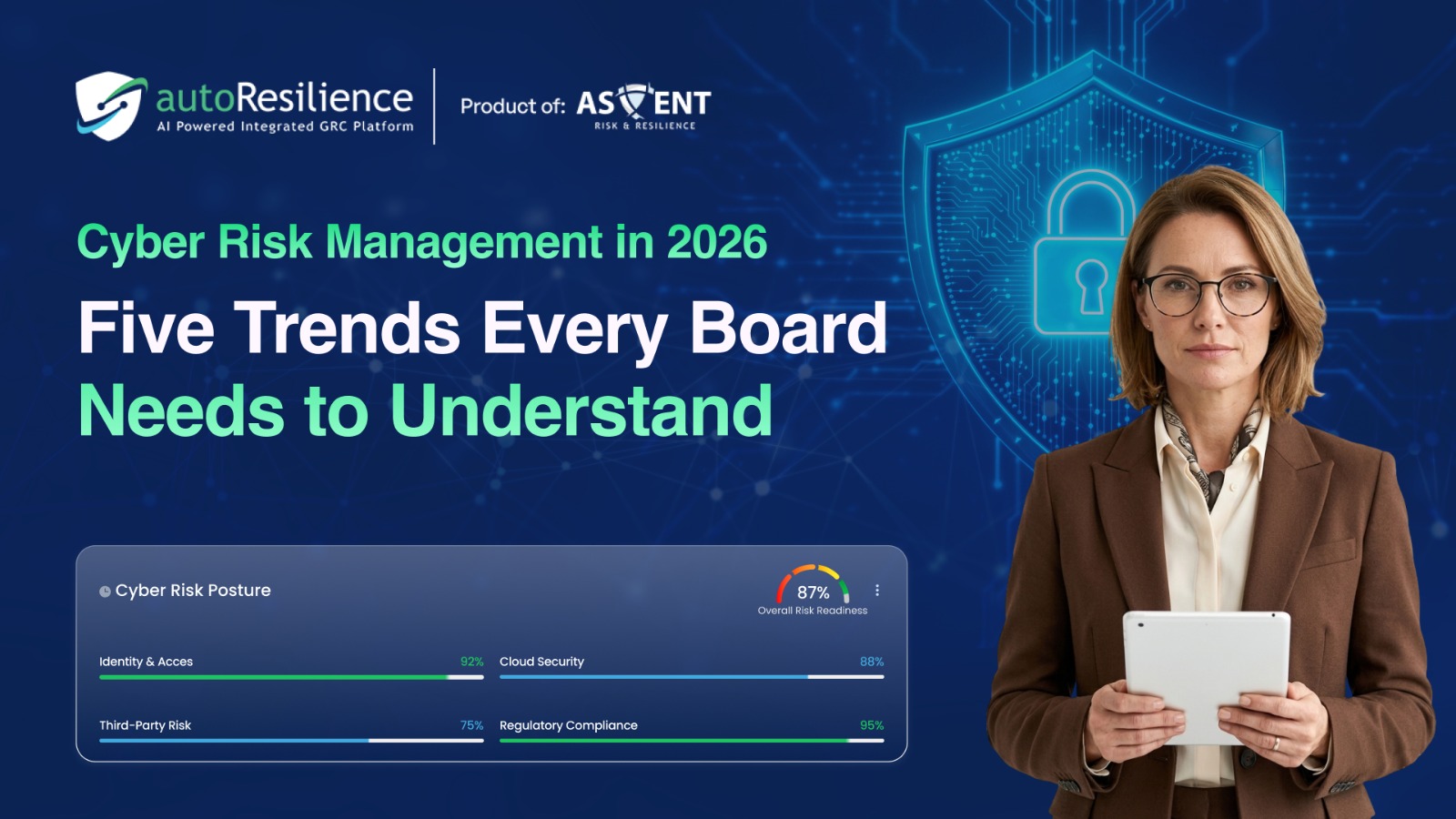
The boardroom conversation about cyber risk management has changed. It used to be a quarterly briefing from the CISO. Today, it’s a standing item on the audit committee agenda with regulators holding directors personally accountable for what happens on their watch.
Cyber risk management is no longer a technology problem with a board update attached to it. It’s a business risk that happens to live inside technology. And boards that haven’t made that distinction yet are the ones most exposed when something goes wrong.
Here are the five trends shaping how the most sophisticated boards are thinking about cyber risk right now backed by the data that makes each one impossible to ignore.
Trend 1: AI Is Now Both the Threat and the Defence
This is the defining tension in cyber risk in 2026. And it requires boards to hold two ideas simultaneously.
On one hand, AI is helping defenders move faster. Organisations using AI tools extensively cut their breach lifecycle by 80 days and saved nearly $1.9 million on average, according to IBM’s Cost of a Data Breach Report 2025. That’s not incremental. That’s a fundamental change in how quickly threats are detected and contained.
On the other hand, AI is making attackers more dangerous. 1 in 6 breaches now involves attackers using AI, most commonly for phishing (37%) and deepfake impersonation (35%).
And the governance gap is alarming. 97% of companies that reported an AI-related breach lacked proper AI governance and security controls.
63% of breached organisations studied lacked AI governance policies, and only 37% had approval processes or oversight mechanisms in place.
The board question this creates is direct: does your organisation have an AI governance framework that covers both how AI is used to defend, and how it might be exploited to attack?
If the answer is no or uncertain that’s a material risk that belongs on the board agenda, not just the IT roadmap.
Trend 2: Regulatory Accountability Is Becoming Personal
For most of the past decade, regulatory consequences for cyber failures fell on institutions. Fines, remediation requirements, enhanced supervision. The institution paid. Leadership moved on.
That model is changing.
With regulators increasingly holding boards and executives liable for compliance failures, inaction can now result in substantial penalties, lost business and irreversible reputational damage.
We’ve already seen this in practice. The UAE’s CBUAE recently imposed a personal fine of AED 300,000 on a bank’s Head of Compliance for failing to fulfil his responsibilities during an AML failure. This isn’t an outlier. It’s a signal.
96% of survey respondents have activities planned to provide assurance over cybersecurity vulnerabilities in 2026, making it the top area of focus in audit plans, according to Gartner’s 2026 Audit Plan Hot Spots report.
The implication for boards is significant. “We were briefed” is no longer a sufficient defence. Boards need to demonstrate active, informed oversight with documented evidence that cyber risk was genuinely understood, not just reported.
Trend 3: The Cost of a Breach Has Never Been Higher, And It’s Rising in Regulated Sectors
The global average cost of a data breach fell to $4.44 million in 2025, the first decline in five years. The headline looks positive.
Look closer, and the picture is more complex.
Healthcare leads with the highest data breach cost at $7.42 million in 2025, marking 14 consecutive years at the top. Financial services follow at $5.56 million. The sectors most important to your board are the most expensive sectors to breach.
Among breached organisations, 32% paid regulatory fines following a breach, with 48% of those fines exceeding $100,000, and a quarter paying over $250,000.
In the Middle East, the financial sector recorded the highest total breach cost, reaching SAR 34 million, followed by energy and industrial at SAR 32 million.
The pattern is consistent across geographies: regulated sectors pay more, recover more slowly, and face compounding consequences, regulatory penalties on top of operational disruption on top of reputational damage.
Boards in banking and financial services cannot treat cyber risk as a probability management exercise. The consequence of a single significant breach is now large enough to be a strategic, not just operational, concern.
Trend 4: Board Reporting Needs to Speak Business, Not Technology
93% of board members agree that cyber risk threatens shareholder value, yet most CISOs still present security operations data structured around cybersecurity functions rather than business outcomes.
This is one of the most persistent and consequential disconnects in enterprise cyber risk governance.
Boards don’t need heat maps showing open vulnerabilities. They need to understand financial exposure, recovery timelines, and whether the organisation’s current cyber investment is actually reducing risk, in terms they can evaluate against other business priorities.
One in three non-executive directors view cyber risks, technology disruption, and innovation challenges as top external threats to shareholder value, according to Gartner research. But that concern often doesn’t translate into the quality of reporting needed to act on it.
Gartner analysts now propose mapping cybersecurity reporting to three financial-report structures: a balance-sheet snapshot of current risk posture, an income-statement view of threat-driven financial impact, and a cash-flow breakdown of resource allocation and budget efficiency.
The practical implication for boards: if your current CISO briefing doesn’t connect cyber risk to financial exposure in terms your CFO would recognise, it’s time to change what you’re asking for.
Trend 5: Third-Party and Supply Chain Cyber Risk Is Now a Board-Level Exposure
Organisations don’t just manage their own cyber risk anymore. They manage the cyber risk of every vendor, cloud provider, SaaS platform, and supply chain partner they depend on.
30% of breaches in 2025 involved data spread across multiple environments, and these had the highest average cost at $5.05 million and the longest average lifecycle at 276 days.
Geopolitical uncertainty, regulatory fragmentation, and rapid AI expansion are all reshaping enterprise risk and elevating expectations for more adaptive cybersecurity strategies and third-party risk sits at the intersection of all three.
A vendor breach becomes your disruption. A cloud provider outage becomes your regulatory notification. A compromised supplier becomes your crisis.
Boards that believe their cyber risk management stops at the organisation’s own perimeter are operating on an outdated model. Regulatory frameworks, DORA, RBI‘s outsourcing guidelines, CBUAE‘s third-party risk expectations have already extended institutional accountability into the supply chain. Boards need to as well.
What This Means for Boards in Practice
Five trends. One consistent implication.
Cyber risk management in 2026 is not manageable as a technology function with a quarterly board update. It requires the same structured governance applied to financial risk, regulatory risk, and strategic risk with real-time visibility, documented oversight, and a clear accountability chain that runs from the board through to the operational teams managing it every day.
Global information security spending is projected to reach $244.2 billion in 2026, up 13.3% year on year. Organisations are spending more. The question boards need to ask is not whether the spend is increasing. It’s whether the risk is actually decreasing.
That question requires a governance infrastructure capable of answering it, continuously, not just quarterly.
The boards asking that question rigorously are the ones that will be least surprised when the next significant disruption arrives.
autoResilience by Ascent helps boards and leadership teams build the governance infrastructure to manage cyber risk alongside operational resilience, compliance, and BCM in one integrated, AI-powered platform.
Explore Cyber Resilience → Run your Compliance Check →