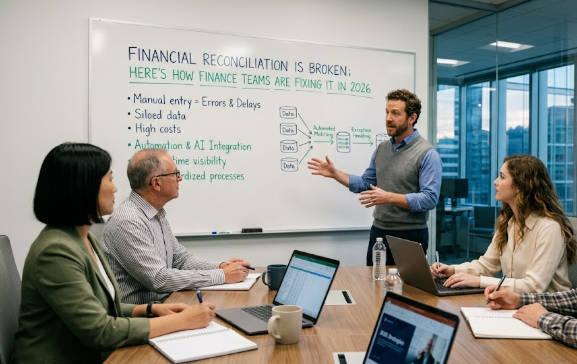
Every month, somewhere in your finance team, someone is staring at two spreadsheets, squinting, trying to figure out why $47,382.16 doesn’t match. That’s how financial reconciliation looks like in most organizations right now.
It’s 11 PM. It’s month-end. And it’s happening in finance departments everywhere, right now.
Financial Reconciliation is one of the least glamorous jobs in finance, and one of the most critical. Get it wrong, and you’re looking at compliance red flags, investor distrust, audit failures, or worse. Get it right, but manually, and you’re burning hundreds of hours a year on a task that adds zero strategic value.
Here’s the uncomfortable truth: the way most companies reconcile their books hasn’t fundamentally changed in decades. Spreadsheets. Manual matching. Tribal knowledge. Someone’s personal macro that only they understand, and that breaks the moment they go on leave.
It’s time to talk about why that has to change, and what the finance teams already ahead of the curve are doing differently.
Why Financial Reconciliation Still Runs on Duct Tape
If reconciliation is so important, why does it still run on outdated processes at so many companies? The honest answer: it’s rarely anyone’s top priority until it fails.
Reconciliation doesn’t get the same attention as revenue forecasting or budgeting because it’s viewed as “back office.” But that back-office task is quietly one of the highest-risk, highest-friction processes in the entire finance function. It touches every transaction, every bank statement, every intercompany transfer, every vendor payment, which means when it breaks, the damage isn’t contained to one line item. It ripples.
Most companies inherit their reconciliation process rather than designing it. A spreadsheet template gets built by someone years ago. It gets copied, modified, patched. New team members learn it by watching someone else do it, not from documented process. Over time, it becomes something everyone tolerates but no one actually trusts.
Why Manual Financial Reconciliation Is a Silent Budget Killer
Most finance leaders don’t realize how much manual reconciliation actually costs until they measure it. A few uncomfortable numbers worth sitting with:
- Finance teams can spend up to 30% of month-end close just on reconciliation tasks
- Manual data entry carries an error rate of roughly 1% which sounds small until you’re processing thousands of transactions a month
- Every reconciliation error caught late can mean re-opening closed books, re-running reports, and re-explaining variances to leadership or auditors
- Skilled finance professionals people you’re paying for judgment and analysis spend meaningful chunks of their week doing what is essentially data entry with extra steps
The real cost isn’t just time. It’s opportunity cost. Every hour your team spends matching line items by hand is an hour they’re not spending on forecasting, variance analysis, or the strategic work that actually moves the business forward. Multiply that across a team, across a year, and you’re often looking at the equivalent of a full-time role’s worth of hours spent on work that adds no analytical value, just verification.
There’s also a quieter cost: talent retention. Skilled finance professionals didn’t get their degrees and certifications to spend their careers manually matching line items. Teams that automate the drudgery tend to retain talent longer, because the job actually uses people’s skills instead of wasting them.
The 3 Warning Signs Your Financial Reconciliation Process Is Failing You
1. Month-end close keeps creeping later.
If close used to take 3 days and now takes 7, that’s not “just how it is”, that’s a process problem compounding quietly, usually as transaction volume grows faster than your team’s capacity to manually match it.
2. Your team dreads reconciliation day.
When finance professionals describe recon as “the worst part of the job,” that’s not a culture issue, it’s a tooling issue. Dread is usually a sign that the process is repetitive, error-prone, and disconnected from any sense of progress or control.
3. Discrepancies get “explained away” instead of resolved.
If your team is writing off small variances just to move forward and hit a deadline, you’re accumulating risk that will eventually surface, usually during an audit, when it’s most expensive and most stressful to fix. Small unresolved discrepancies compound. What looks like a rounding error today can be a symptom of a systemic data issue tomorrow.
A fourth sign, worth adding: you can’t answer “why” quickly. If a CFO or auditor asks why a specific number changed between two close periods, and the answer takes hours of digging through spreadsheet versions to reconstruct, that’s a transparency problem baked into your process, not a one-off inconvenience.
What’s Really Happening Behind the Scenes of a Broken Process
It’s worth naming what manual reconciliation actually is, mechanically, because the process itself explains why it fails so predictably.
Someone exports data from one system say, the bank feed. Someone else exports from another, the ERP or ledger. Then, line by line, a human being tries to match entries across two datasets that were never designed to talk to each other. Formatting differs. Timing differs (a transaction posted on the 30th in one system might show up on the 1st in another). Descriptions differ. A payment that’s one line in the bank feed might be three-line items in the ledger.
Humans are genuinely bad at this kind of repetitive pattern-matching at scale, not because they lack skill, but because it’s fundamentally a job better suited to software. Fatigue sets in. Attention drifts on the 400th line item. And because the stakes are high, that fatigue-driven error doesn’t just cost time to fix, it can trigger a much larger investigation to figure out where things actually went wrong.
What Modern Financial Reconciliation Actually Looks Like
The shift happening across finance teams right now isn’t about working harder, it’s about removing the manual matching entirely, and redesigning the process around continuous verification instead of a mad scramble at month-end.
Modern reconciliation software:
- Auto-matches transactions across multiple data sources in real time, not just at month-end, so discrepancies surface when they happen, not weeks later
- Flags true exceptions only instead of making humans check every single line, it surfaces just the ones that genuinely need judgment, cutting review volume dramatically
- Creates an audit trail automatically, so you’re never scrambling to reconstruct “what happened here” six months later when an auditor asks
- Scales without adding headcount as transaction volume grows, the system absorbs it instead of your team drowning in it
- Standardizes the process so it doesn’t live in one person’s head or one fragile spreadsheet macro
This isn’t about replacing finance professionals. It’s about freeing them from data-matching drudgery so they can do the analytical, judgment-driven work that actually requires a human brain, the work that got them into finance in the first place.
What to Look for When Evaluating a Reconciliation Solution
If you’re starting to explore automation, a few questions are worth asking of any tool you evaluate:
- Does it integrate with your existing systems (ERP, banking platforms, payment processors) without requiring a full data migration?
- How does it handle exceptions, does it just flag mismatches, or does it help explain why they don’t match?
- Is the audit trail built in by default, or does someone still have to manually document what happened?
- Can it scale with transaction volume without requiring proportional headcount growth?
- How long does implementation actually take, weeks, or months?
These questions matter more than flashy dashboards. The best reconciliation tools are the ones your team barely thinks about because they just quietly work.
The Bottom Line
Reconciliation isn’t going away, transactions will always need to be verified, matched, and accounted for. But how it gets done is changing fast, and the finance teams making the switch now are the ones who’ll spend next month-end doing strategic work instead of squinting at spreadsheets at 11 PM, hoping a $47,382.16 discrepancy resolves itself.
The gap between “we reconcile manually because that’s how we’ve always done it” and “we reconcile automatically and spend our time on analysis instead” is smaller and faster to close than most finance leaders assume.
See It in Action
Curious what reconciliation looks like when it’s actually automated, matching, exceptions, audit trails, and all?
Explore our Financial Reconciliation Software solution and see how finance teams are cutting close time and catching discrepancies before they become problems. Book a Demo now!