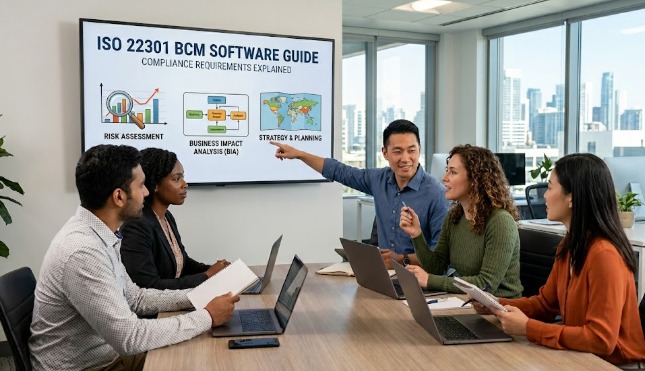
ISO 22301 BCM Software Guide: Compliance Requirements Explained
Achieving business continuity compliance has never been more critical or more complex. Here's everything you need to know about ISO 22301 and how BCM software makes compliance manageable.
...
Shambhavi Singh
Achieving business continuity compliance has never been more critical or more complex. Here’s everything you need to know about ISO 22301 and how BCM software makes compliance manageable.
What Is ISO 22301?
ISO 22301 is the internationally recognized standard for Business Continuity Management (BCM). Published by the International Organization for Standardization (ISO), it provides a structured framework that helps organizations prepare for, respond to, and recover from disruptive incidents whether that’s a cyberattack, natural disaster, supply chain failure, or pandemic.
At its core, it requires organizations to establish, implement, maintain, and continually improve a Business Continuity Management System (BCMS). The standard applies to organizations of all sizes and industries, from healthcare and finance to manufacturing and government.
Achieving ISO 22301 certification signals to clients, stakeholders, and regulators that your organization is resilient, reliable, and prepared for the unexpected.
Why ISO 22301 Compliance Matters in 2026
The business landscape is more volatile than ever. According to industry research, the average cost of unplanned downtime has reached tens of thousands of dollars per minute for large enterprises. Regulatory pressure is also mounting globally, with governments mandating operational resilience standards across critical sectors.
ISO 22301 compliance delivers measurable business value:
Risk reduction through proactive identification of threats and vulnerabilities
Regulatory alignment with frameworks like DORA, HIPAA, and NIS2
Competitive advantage by demonstrating resilience to customers and partners
ISO 22301 follows the High-Level Structure (HLS) used by other ISO management standards (like ISO 27001 and ISO 9001), making it easier to integrate into existing management systems. Here are the core compliance requirements:
1. Context and Scope (Clause 4)
Organizations must define the internal and external factors that affect their BCMS. This includes identifying interested parties, legal and regulatory requirements, and the scope of the BCMS which parts of the business it covers.
2. Leadership and Commitment (Clause 5)
Top management must demonstrate active commitment to the BCMS. This means assigning roles and responsibilities, establishing a BCM policy, and ensuring that business continuity objectives are aligned with the organization’s strategic direction.
3. Planning and Risk Assessment (Clause 6)
Organizations must conduct a structured Business Impact Analysis (BIA) and risk assessment to identify critical functions, acceptable downtime thresholds (Recovery Time Objectives / RTOs), and recovery point requirements (RPOs). These findings drive the entire continuity strategy.
4. Support and Resources (Clause 7)
Adequate resources including personnel, tools, and documented information must be allocated. This clause also covers awareness and training, ensuring staff understand their roles during a disruption.
5. Business Continuity Plans and Procedures (Clause 8)
This is the operational heart of ISO 22301. Organizations must develop, implement, and maintain:
Business continuity plans (BCPs) for critical functions
Incident response procedures
Communication strategies for internal and external stakeholders
Recovery strategies based on BIA findings
6. Performance Evaluation (Clause 9)
The standard requires ongoing monitoring, measurement, and auditing of the BCMS. Organizations must conduct regular exercises and tests of their BCPs to ensure plans remain effective and up to date.
7. Continual Improvement (Clause 10)
When nonconformities are identified through audits, exercises, or actual incidents corrective actions must be taken. ISO 22301 is not a one-time certification; it demands a culture of continuous improvement.
What Is BCM Software and Why Do You Need It?
Manually managing an ISO 22301-compliant BCMS through spreadsheets, shared drives, and email chains is not just inefficient, it’s a compliance risk. BCM software provides a centralized, automated platform to manage every aspect of your business continuity program.
Leading BCM software solutions typically include:
BIA and Risk Assessment modules that guide users through structured assessments and automatically generate reports
Plan authoring and management tools with version control and approval workflows
Exercise and testing schedulers that track participation, results, and improvement actions
Real-time incident management dashboards for activating and coordinating response
Document control and audit trails that demonstrate compliance to auditors
Integration capabilities with IT service management (ITSM), GRC platforms, and communication tools
How BCM Software Supports ISO 22301 Compliance
BCM software directly maps to ISO 22301 clauses, making compliance structured and auditable:
ISO 22301 Clause
BCM Software Feature
Context & Scope
Stakeholder and scope management modules
BIA & Risk Assessment
Automated BIA workflows, risk registers
BCP Development
Plan templates, approval workflows
Training & Awareness
Training tracking, role-based access
Exercises & Testing
Exercise scheduling, after-action reports
Audit & Review
Compliance dashboards, evidence repositories
Incident Management
Real-time activation and communication tools
Choosing the Right BCM Software for ISO 22301
Not all BCM platforms are created equal. When evaluating solutions, look for:
1. ISO 22301 Alignment The software should be purpose-built or explicitly mapped to ISO 22301 requirements, not a generic project management tool repurposed for BCM.
2. Ease of Use Business continuity involves stakeholders across the entire organization. The platform must be intuitive enough for non-technical users to contribute to plans, complete exercises, and respond to incidents.
3. Scalability Whether you’re managing BCM for a single site or a global enterprise with hundreds of critical processes, the software should scale without becoming unwieldy.
4. Audit-Ready Reporting Built-in reporting that maps evidence to ISO 22301 clauses saves enormous time during certification audits and annual reviews.
5. Vendor Support and Updates The ISO standard evolves. Choose a vendor committed to keeping the platform aligned with the latest version of ISO 22301 and emerging regulatory requirements.
The Road to ISO 22301 Certification
Achieving certification typically involves four stages:
Gap Analysis — Assess your current BCM maturity against ISO 22301 requirements
Internal Audit and Management Review — Validate readiness before the formal audit
Certification Audit — A two-stage audit conducted by an accredited certification body
BCM software accelerates every stage by organizing documentation, automating workflows, and generating audit-ready evidence.
Conclusion
ISO 22301 is more than a compliance checkbox, it’s a strategic framework that builds genuine organizational resilience. But managing a BCMS manually is unsustainable at scale. The right BCM software transforms compliance from a burdensome administrative task into an integrated, continuous practice.
Whether you’re pursuing ISO 22301 certification for the first time or maturing an existing program, investing in purpose-built BCM software is one of the highest-ROI decisions your organization can make.
Start with a gap analysis, align your tools to the standard, and build a business continuity program that protects your people, operations, and reputation, no matter what disruption comes next.
Shambhavi Singh is a Marketing Executive at Ascent Risk & Resilience, where she contributes to brand communication, content strategy, and digital storytelling across the organization’s risk and resilience solutions. With a background spanning content writing, voice-over artistry, anchoring, public speaking, and social impact, she brings both creativity and clarity to every message she crafts.
Shambhavi’s passion for communication started early in her hometown of Varanasi, where her curiosity for culture and heritage shaped her worldview. A natural storyteller and confident speaker, she has built a strong presence as a social media writer and continues to use her voice to inform, inspire, and engage audiences.
Driven by a blend of will and skill, she is committed to building meaningful connections, leading with empathy, and contributing to initiatives that create positive change. A social worker at heart and a marketer by profession, Shambhavi combines creativity, purpose, and leadership in everything she does.