In this modern era where volatility is the new norm, organizations are no longer getting ready only for conventional business risks. Geopolitical instability and wartime disruptions have emerged as visible threats that can bring all operations to a halt. From cyberattacks and infrastructure breakdowns to financial instability and misinformation, wartime environments create a difficult and complicated situation. These situations can lead to delayed or ineffective response. Thus, Crisis Management Platforms become a non-negotiable.
Traditional crisis management approaches are usually manual, fragmented, and reactive. What organizations need instead is a systematic, technology-driven approach that enables real-time visibility, fast decision-making, and coordinated response. This is where crisis management platforms play a pivotal role in steering an organisation when the big blow hits.
When Russia invaded Ukraine on February 24, 2022, the war that broke out had a well-documented devastating impact on society and the people of Ukraine. This includes a huge impact on businesses. Companies in Ukraine were forced to relocate and/or shut down all or some of their activities. Factories, stores, and buildings were ruined. Hundreds of thousands of the workforce were serving in the army, and millions had fled the country. Regardless of where in Ukraine a company is located, business leaders have had to find ways to cope with the instability and impact of the war.
However, in the crisis management field, we know almost nothing about the crisis management of companies situated in an active warzone. What goes on inside companies when their country is invaded and an armed conflict takes place, destroying lives, buildings, economy, and businesses? How do business leaders respond to and manage such devastating and uncertain circumstances? These situations push companies to the edge and make them question their own choices.
Understanding Wartime Disruptions in a Business Context
Wartime disruptions are not limited to physical conflict zones. Their ripple effects transcend boundaries. They impact organizations across industries and jurisdictions. The core problems that wartime disruptions create in a business context are:
- Operational disruptions: Damage to infrastructure, power outages, or restricted access to facilities can halt business operations.
- Cybersecurity threats: Wartime often hits the surge button in state-sponsored cyberattacks. They often target financial institutions, utilities, and critical infrastructure.
- Supply chain breakdowns: Border closures, trade restrictions, and operational bottlenecks disrupt supply chains.
- Regulatory and compliance pressure: Governments introduce emergency guidelines which require faster actions and rapid compliance.
- Workforce risks: Employee safety, their relocation, and communication between the team become immediate priorities.
- Reputational risk: Poor crisis response can damage the trust of partners, stakeholders, community, etc.
Why Traditional Crisis Management Fails
Many organizations still depend on traditional crisis management frameworks spreadsheets, email threads, static plans, and siloed teams. While these may work for isolated incidents, they struggle under difficult wartime situation.
The main limitations include:
- Lack of real-time visibility: Decision-makers often bear the burden of outdated or incomplete information.
- Delayed response times: Manual coordination slows down incident response.
- Fragmented communication: Teams across departments lack a unified view of the situation.
- Inconsistent execution: Crisis plans are not always followed effectively due to lack of automation.
- Limited scalability: Handling multiple concurrent crises becomes nearly impossible.
These gaps highlight the need for a more advanced, integrated solution.
What is a Crisis Management Platform?
A crisis management platform is a centralized system driven by technology that equips organizations to prepare for, respond to, and recover from disruptive events. It streamlines risk management, prompt incident response, communication and compliance into a single comprehensive framework.
The key capabilities of a crisis management platform generally include incident detection, tracking, automated workflows, escalation protocols, real-time dashboards, analytics, centralized communication systems, regulatory reporting, and integration with other enterprise systems.
Role of Crisis Management Platforms During Wartime
1. Real-Time Insights
During a war, the situation on the ground can change with the speed of light. Organizations need continuous, real-time insights to make well-thought-of decisions.
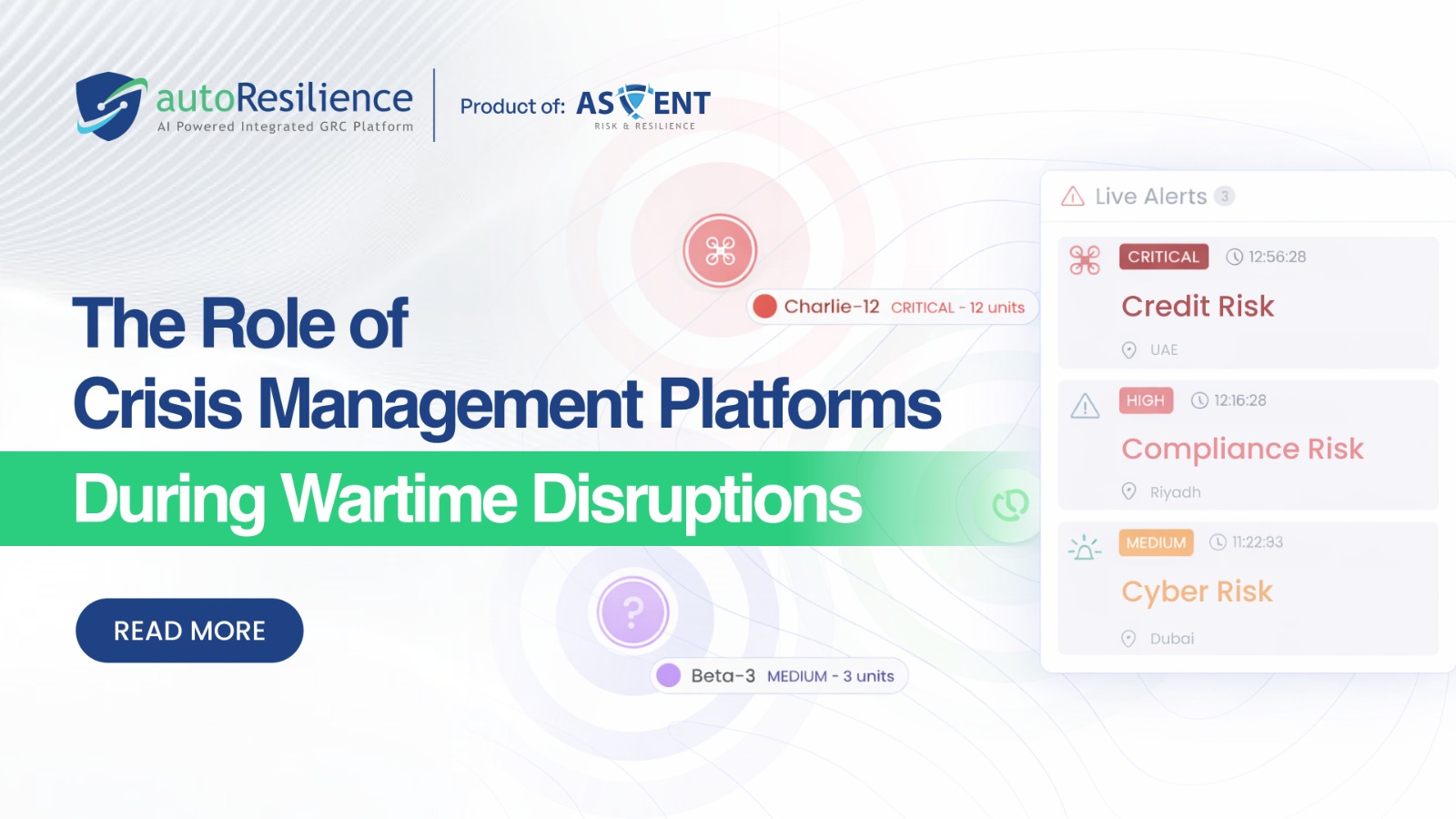
Crisis management platforms provide real-time dashboards to stay up to date with incidents, risks, and responses. It also provides integration with external data sources like news feeds, threat intelligence, government alerts and centralized visibility across all business units and geographies.
This allows the leadership to take decisions that are data driven and thus move away from guesswork.
2. Quicker Incident Response and Coordination
Speed is very important during any crisis. Late responses can lead to heavy financial losses, regulatory fines, and reputational damage.
Crisis management platforms trigger predefined response protocols, assign tasks to relevant stakeholders, allow real-time collaboration across teams and ensure accountability through tracking and audit trails. This reduces the amount of response time and smoothens the overall process.
3. Strengthening Cyber Security
Wartime landscape often witnesses an upsurge in cyber warfare. Financial organizations and crucial infrastructure providers are prime targets.
Crisis platforms enhance cybersecurity response by integrating with security tools for incident detection, automating breach response procedures, facilitating rapid recovery and maintaining detailed logs for forensic analysis and compliance.
This makes sure that organizations can respond to cyber incidents with precision and speed.
4. Ensuring Regulatory Compliance Under Pressure
Regulatory expectations do not pause during crises. In reality, they often intensify. Organizations must continue to meet reporting requirements, even under extreme conditions.
Crisis management platforms help by automating compliance reporting, maintaining audit-ready documentation, aligning response actions with regulatory frameworks and providing traceability for every decision and action.
This reduces the risk of non-compliance and associated penalties.
5. Enhancing Communication and Stakeholder Management
Clear and timely communication is crucial during wartime disruptions. Misinformation or delayed updates can create panic and erode trust.
Crisis platforms allow centralized communication with employees, customers, and partners, predefined communication templates for faster messaging, multi-channel alerts (email, SMS, app notifications) and consistent information dissemination.
This makes sure that stakeholders remain informed and confident.
6. Managing Workforce Safety and Continuity
Employee safety becomes a top priority during wartime. Organizations must ensure their workforce is protected while maintaining business continuity.
Crisis platforms support employee tracking, status updates, emergency communication, coordination of evacuation or relocation efforts and remote work enablement and monitoring.
This helps organizations balance safety with operational continuity.
7. Supply Chain Visibility and Risk Mitigation
Supply chains are extremely sensitive during wartime. Disruptions can cascade across the entire business ecosystem.
Crisis management platforms provide visibility into supplier risks, early warning systems for disruptions, scenario planning, impact analysis, and coordination with vendors and partners.
This enables proactive risk mitigation and continuity planning.
8. Data-Driven Decision Making with AI
Modern crisis management platforms like autoResilience.ai utilise AI and analytics to improve the decision-making process. The core capabilities of our platform include predictive risk analysis, automated incident classification and prioritization, scenario simulation, forecasting impact and natural language queries for quick insights.
AI acts as a “co-pilot,” someone second in command that is helping leaders anticipate risks and respond effectively.
Building Organizational Resilience Through Crisis Platforms
Crisis management platforms are not just reactive tools. These platforms play a key role in building long-term resilience.
They allow organizations to conduct regular drills and simulations, continuously update and improve crisis plans, learn from past incidents through data analysis and align crisis management with overall risk and compliance strategies
In wartime scenarios, this resilience can be the difference between survival and failure.
Key Considerations When Implementing a Crisis Management Platform
To maximize effectiveness, organizations should consider:
- Scalability: Can the platform handle multiple simultaneous crises?
- Integration: Does it connect with existing systems (ERP, HRMS, security tools)?
- User adoption: Is it intuitive and easy for teams to use under pressure?
- Customization: Can workflows be tailored to specific organizational needs?
- Security: Does it meet cybersecurity and data protection standards?
Choosing the right platform is critical to achieving desired outcomes.
The Future of Crisis Management in a Volatile World
As geopolitical risks continue to evolve, crisis management will become an increasingly strategic function. Organizations will need to move beyond compliance-driven approaches and adopt a resilience-first mindset.
Emerging trends include:
- Greater use of AI and automation
- Integration of cyber and physical risk management
- Increased regulatory scrutiny
- Focus on real-time intelligence and predictive analytics
Crisis management platforms will be at the center of this transformation.
Conclusion
Wartime disruptions present one of the most complex and high-impact challenges that organizations can face. In such an environment, the capability to respond quickly, coordinate effectively, and maintain resilience is not optional. Rather, it is essential.
Crisis management platforms provide the structure, speed, and intelligence needed to navigate these challenges. By enabling real-time visibility, automated response, and continuous governance, they empower organizations to move from reactive crisis handling to proactive resilience.
In a world where uncertainty is the only constant, investing in a robust crisis management platform is not just a technological decision. It is a strategic imperative.