Why Regulatory Change Management Must Be Automated in 2026?
The contemporary regulatory landscape is evolving and changing rapidly. This is a dangerous landscape where regulations evolve and change every minute. A myriad of stringent regulations kee...
Shambhavi Singh
The contemporary regulatory landscape is evolving and changing rapidly. This is a dangerous landscape where regulations evolve and change every minute. A myriad of stringent regulations keep coming up in various industries like BFSI, health, etc. The pace of regulatory change becomes even faster with rising customer expectations, technological advancements, legal requirements, geopolitical shifts, etc. The several technological changes in the banking industry, insurance sector, etc., have caused even more stringent rules and regulations to be put in place. These ever-increasing regulations become a daunting task to manage for the enterprises. This is where Regulatory Change Management steps in the picture.
What is Regulatory Change Management?
Regulatory change management is the process of keeping up with and implementing new policies, standards, and controls aligned with new regulatory requirements. It’s a vital part of any business and every compliance program, but it can be difficult to keep up with constant changes. It is the process of aligning your organization as per the evolving regulations in order to protect your enterprise from hefty fines. One major function of regulatory change management is to assess, anticipate, and comply with laws and obligations of the specific industry of which your organization is a part.
Organizations usually start out by building an ‘obligations register’ of applicable regulations, standards, and legislation that are applicable to their business. They must then map each regulation to the relevant business processes, policies, and procedures. This makes it easy to understand the potential impact of what needs to be altered should the regulation change in the future.
The next crucial step is monitoring the changes in the regulations. It is important to keep an eye out for changes, updates, and expiration of requirements. It is important to document the changes and accordingly work out the workflow changes with the important stakeholders.
RCM sits at the intersection of compliance, risk management, legal interpretation, operations, and governance. It ensures that regulatory obligations are not treated as isolated legal texts but as actionable requirements embedded into day-to-day business practices.
In mature organizations, regulatory change management is not a one-time project—it is a continuous lifecycle.
Key Steps of Effective Regulatory Change Management
An effective RCM program addresses several interconnected dimensions.
1. Defining the Applicable Regulatory Universe
Organizations must first clearly define which regulators, laws, standards, and supervisory bodies apply to them. This includes:
Jurisdiction-specific regulations
Industry regulators
Data protection and cybersecurity authorities
Sectoral standards and codes of practice
Third-party and supply chain obligations
Without a defined regulatory universe, compliance efforts become fragmented and incomplete.
2. Alignment With Existing Obligations
New regulations rarely exist in isolation. They often overlap with existing laws, standards, and internal policies. RCM requires organizations to map new requirements against current controls to identify:
Redundancies
Conflicts
Gaps
Opportunities for consolidation
This alignment prevents unnecessary duplication of effort and reduces compliance fatigue.
3. Monitoring Regulatory Developments
Regulatory change is not limited to final legislation. Organizations must track:
Draft laws and consultation papers
Regulatory guidance and circulars
Enforcement actions and fines
Industry advisories and supervisory priorities
Early awareness allows organizations to prepare proactively rather than react under pressure.
4. Impact and Risk Assessment
Every regulatory change affects the organization differently. Effective RCM includes structured impact assessments to understand:
Which processes and systems are affected
How the risk profile changes
Which business units are impacted
Whether new controls are required
This step connects regulatory compliance directly to enterprise risk management.
5. Control Design and Implementation
Once impacts are understood, organizations must adapt or execute:
Policies and procedures
Technical and security controls
Contractual clauses
Training and awareness programs
This translation from “regulatory language” to “operational reality” is where many compliance programs struggle.
6. Communication and Stakeholder Engagement
Regulatory changes affect multiple stakeholders:
Employees
Senior management
Third-party vendors
Customers and partners
Clear communication ensures accountability and reduces the risk of misinterpretation or inconsistent application.
7. Monitoring and Continuous Improvement
RCM does not end with implementation. Organizations must:
Monitor effectiveness
Track compliance metrics
Review incidents and breaches
Update controls as regulations evolve
This feedback loop is essential for long-term resilience.
Challenges Organizations Face in Managing Regulatory Change
Despite its importance, regulatory change management presents several practical challenges.
Cost Pressure
Building and maintaining compliance programs requires significant investment in people, tools, and advisory support. Smaller organizations often struggle to justify these costs, even though non-compliance is far more expensive in the long run.
Time and Resource Constraints
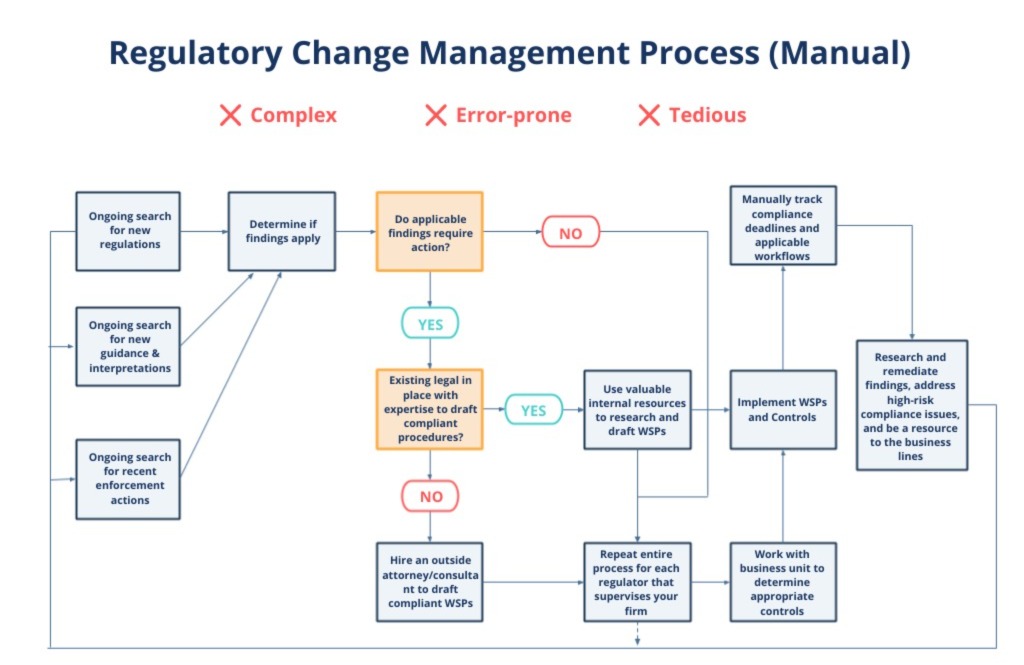
Manual tracking of regulatory updates through legal teams or external advisors is slow and resource-intensive. By the time changes are interpreted and implemented, enforcement deadlines may already be approaching.
Regulatory Complexity
Modern regulations are detailed, technical, and often ambiguous. Interpreting intent, scope, and applicability requires deep expertise and cross-functional collaboration.
Organizational Agility
Regulatory changes may require rapid adjustments to processes, systems, or business models. Organizations that lack flexibility struggle to adapt without disrupting operations.
Compliance Risk
Failure to implement regulatory changes correctly can lead to:
Audit findings
Regulatory investigations
Financial penalties
Reputational damage
Loss of customer trust
These risks often extend beyond compliance teams and affect the entire enterprise.
Why Regulatory Change Management must be Automated?
Speed & Real-Time Monitoring: AI sifts vast regulatory data faster, identifying changes instantly, not periodically, keeping companies ahead.
Accuracy & Error Reduction: NLP and ML reduce human misinterpretation of complex rules, cutting errors inherent in spreadsheets.
Efficiency & Cost Savings: Automating tedious tasks (tracking, assignment, evidence) frees staff for strategic work and avoids costly non-compliance fines.
Scalability: Automated systems handle growing compliance needs and new jurisdictions without proportional manual effort.
Comprehensive Audit Trail: Digital records track every step (who, what, when), proving compliance to regulators and ensuring accountability.
Proactive Risk Mitigation: Early impact assessment and automated workflows enable swift operational changes, transforming reactive compliance into proactive strategy.
Streamlined Workflows: Centralized platforms assign tasks, collect evidence (screenshots, training records), and provide continuous monitoring, creating unified processes.
The Five Core Components of an Automated Regulatory Change Management Framework
While implementations vary, most mature RCM frameworks include five foundational components.
1. Regulatory Intelligence
A structured view of applicable regulations, regulatory bodies, and emerging developments.
2. Change Management Process
Defined workflows for identifying, assessing, approving, and implementing regulatory changes, with clear ownership and accountability.
3. Communication and Training
Automated mechanisms to inform stakeholders and ensure employees understand new obligations and expectations.
4. Monitoring and Reporting
Automated dashboards and reporting structures to track compliance status and demonstrate regulatory readiness.
5. Governance and Oversight
Clear governance structures to oversee regulatory change management, resolve conflicts, and ensure strategic alignment.
Strategic Goals of Automated Regulatory Change Management
At its core, RCM aims to:
Enable informed decision-making
Coordinate compliance across functions
Minimize business disruption
Reduce regulatory and operational risk
Strengthen governance and accountability
Support sustainable growth
When executed well, regulatory change management becomes a strategic enabler rather than a constraint.
Moving Toward Compliance Resilience
The regulatory environment will continue to evolve as technology, geopolitics, and societal expectations change. Organizations that treat automating regulatory change management as a core capability and not just a compliance checkbox will be better positioned to adapt, innovate, and grow.
By investing in structured processes, clear governance, and enabling technology, organizations can transform regulatory complexity into operational clarity and long-term resilience.
Regulatory change is inevitable. Disruption does not have to be.
Organizations that automate regulatory change management gain more than just compliance. They gain predictive analytics, confidence, agility, and trust in an increasingly regulated world.
Shambhavi Singh is a Marketing Executive at Ascent Risk & Resilience, where she contributes to brand communication, content strategy, and digital storytelling across the organization’s risk and resilience solutions. With a background spanning content writing, voice-over artistry, anchoring, public speaking, and social impact, she brings both creativity and clarity to every message she crafts.
Shambhavi’s passion for communication started early in her hometown of Varanasi, where her curiosity for culture and heritage shaped her worldview. A natural storyteller and confident speaker, she has built a strong presence as a social media writer and continues to use her voice to inform, inspire, and engage audiences.
Driven by a blend of will and skill, she is committed to building meaningful connections, leading with empathy, and contributing to initiatives that create positive change. A social worker at heart and a marketer by profession, Shambhavi combines creativity, purpose, and leadership in everything she does.