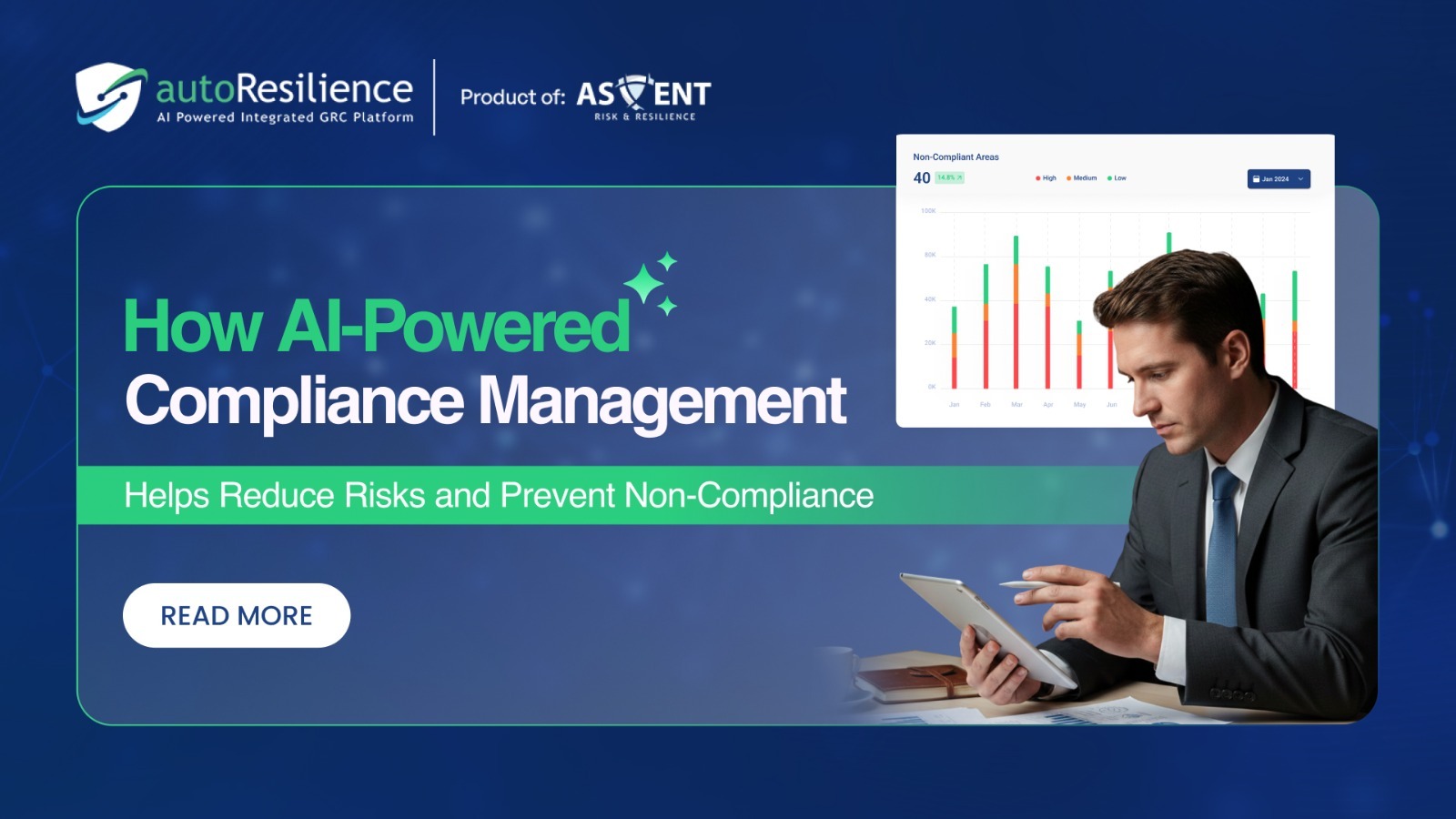
How AI-Powered Compliance Management Helps Reduce Risks in 2026
We totally understand! AI is everywhere, from your Instagram algorithm to finance. From marketing to engineering and customer support, generative AI has become the most important catalyst f...
Shambhavi Singh
We totally understand! AI is everywhere, from your Instagram algorithm to finance. From marketing to engineering and customer support, generative AI has become the most important catalyst for increasing productivity and transformation. Various studies have shown that AI can increase productivity by up to 66%, making it one of the most impactful technologies of the decade. AI-powered compliance management thus becomes very important in this digital era.
Therefore, it comes as no surprise that compliance leaders are wondering about:
How can AI-powered compliance management help reduce risk and prevent non-compliance?
As per the records, Governance, Risk, and Compliance (GRC) functions have been slower to intermingle with new technologies. As a matter of fact, recent studies show that less than 20% of compliance and security leaders proactively utilize generative AI tools in their compliance programs. This bridge isn’t due to the lack of needs. Rather, it’s more about legacy systems, avoiding risk, and the difficult regulatory environments.
Yet the opportunity that stands at the crossroads is huge.
As regulations continue to evolve and increase across industries, from GDPR and HIPAA to SOX, ISO standards, and sector-specific mandates, traditional manual & spreadsheet-driven compliance processes are becoming redundant and thus failing to survive. Static spreadsheets, periodic audits, and reactive reporting are no longer sufficient to keep organizations compliant, secure, and audit-ready.
This is where AI-powered compliance management systems come in.
By combining automation, machine learning, natural language processing (NLP), and real-time analytics, AI-driven compliance solutions help organizations move from reactive compliance to proactive risk prevention.
Whether you’re a Chief Compliance Officer, CISO, or managing compliance for a developing enterprise, understanding AI’s role in compliance is no longer optional. It’s non-negotiable.
Compliance Management Systems: A Brief Overview
Before diving into AI and its impact, let’s get in-depth with the general structure and framework.
A Compliance Management System (CMS) is a structured framework that helps enterprises follow applicable laws, rules, regulations, standards, and internal policies. It’s not just a tool. It’s a combination of people, processes, policies, and technology working together to ensure compliance.
Core Components of a Compliance Management System
Most modern compliance management systems support the following functions:
Policy creation, documentation, and version control
Regulatory change management
Risk assessments and control mapping
Continuous compliance monitoring
Evidence collection and audit trail management
Automated reporting and dashboards
Employee training, attestations, and certifications
Internal and external audit preparation
For highly regulated industries such as financial services, healthcare, government, energy, and technology, a CMS is mission-critical. A single compliance failure can lead to regulatory fines, operational disruption, reputational damage, and loss of customer trust.
A well-implemented CMS transforms compliance from a checkbox exercise into a strategic business function. It helps organizations anticipate regulatory changes, manage compliance risks proactively, and demonstrate accountability to regulators and stakeholders.
However, traditional compliance management systems have a major limitation: they rely heavily on manual effort.
The Problem with Traditional Compliance Management
Despite advancements in GRC software, many compliance programs still depend on:
Manual risk assessments
Spreadsheet-based controls tracking
Periodic audits instead of continuous monitoring
Human interpretation of complex regulations
Siloed compliance data across departments
This approach creates several challenges:
1. Reactive Compliance
Traditional compliance programs identify issues after they occur, often during audits or regulatory reviews. By then, remediation is costly and time-consuming.
2. Human Error and Inconsistency
Manual processes increase the risk of oversight, inconsistent interpretations, and documentation gaps, all common causes of non-compliance.
3. Regulatory Overload
Regulatory requirements are growing faster than compliance teams can track them. Keeping up with global regulations manually is nearly impossible.
4. Limited Visibility into Risk
Without real-time monitoring and analytics, organizations lack insight into emerging compliance risks and control failures.
This is precisely why AI-powered compliance management is gaining traction.
How AI-Powered Compliance Management Reduces Risk
AI fundamentally changes how compliance programs operate. Instead of relying on static rules and manual reviews, AI enables continuous, intelligent, and data-driven compliance management.
Here’s how it helps reduce compliance risks and prevent violations.
1. Continuous Compliance Monitoring in Real Time
One of the biggest advantages of AI in compliance is real-time monitoring.
Traditional compliance programs rely on periodic audits, quarterly, annually, or after an incident occurs. AI-powered compliance management systems, on the other hand, can continuously analyze:
Transactions
User activity
System logs
Communications
Access patterns
Machine learning algorithms detect anomalies, unusual behavior, or deviations from expected controls, often before they escalate into compliance failures.
Risk Reduction Impact:
Early detection of control breakdowns
Faster remediation of issues
Reduced likelihood of regulatory violations
Continuous monitoring transforms compliance from reactive firefighting into proactive risk prevention.
2. Automated Regulatory Change Management
Tracking regulatory changes is one of the most resource-intensive compliance activities.
AI-powered tools can automatically:
Scan regulatory updates across jurisdictions
Interpret new laws using natural language processing
Identify which regulations apply to your organization
Map changes to existing controls and policies
Trigger workflow updates and alerts
For organizations managing compliance across frameworks like GDPR, HIPAA, SOX, ISO 27001, SOC 2, or industry-specific regulations, AI significantly reduces the risk of missing critical changes.
Risk Reduction Impact:
Lower risk of non-compliance due to outdated controls
Faster adaptation to regulatory changes
Reduced manual review effort
3. Predictive Compliance Risk Analytics
AI doesn’t just analyze what’s happening now. It helps predict what might happen next.
By analyzing historical compliance data, audit findings, incidents, and operational metrics, AI can:
Identify trends in control failures
Predict high-risk areas
Prioritize remediation efforts
Recommend preventive controls
This predictive approach enables compliance teams to focus resources where they matter most.
Risk Reduction Impact:
Proactive mitigation of compliance risks
Better allocation of compliance resources
Reduced likelihood of repeated violations
4. Intelligent Policy and Documentation Management
Documentation is a cornerstone of compliance and a common failure point.
In fact, recent surveys show that nearly 90% of risk, fraud, and compliance professionals view AI as a “force for good.” The organizations that adopt AI early will gain a competitive advantage, not just in compliance, but in resilience, agility, and trust.
The future of compliance isn’t about doing more work.
It’s about working smarter with AI as your compliance ally.
Written by
Shambhavi Singh
Shambhavi Singh is a Marketing Executive at Ascent Risk & Resilience, where she contributes to brand communication, content strategy, and digital storytelling across the organization’s risk and resilience solutions. With a background spanning content writing, voice-over artistry, anchoring, public speaking, and social impact, she brings both creativity and clarity to every message she crafts.
Shambhavi’s passion for communication started early in her hometown of Varanasi, where her curiosity for culture and heritage shaped her worldview. A natural storyteller and confident speaker, she has built a strong presence as a social media writer and continues to use her voice to inform, inspire, and engage audiences.
Driven by a blend of will and skill, she is committed to building meaningful connections, leading with empathy, and contributing to initiatives that create positive change. A social worker at heart and a marketer by profession, Shambhavi combines creativity, purpose, and leadership in everything she does.